



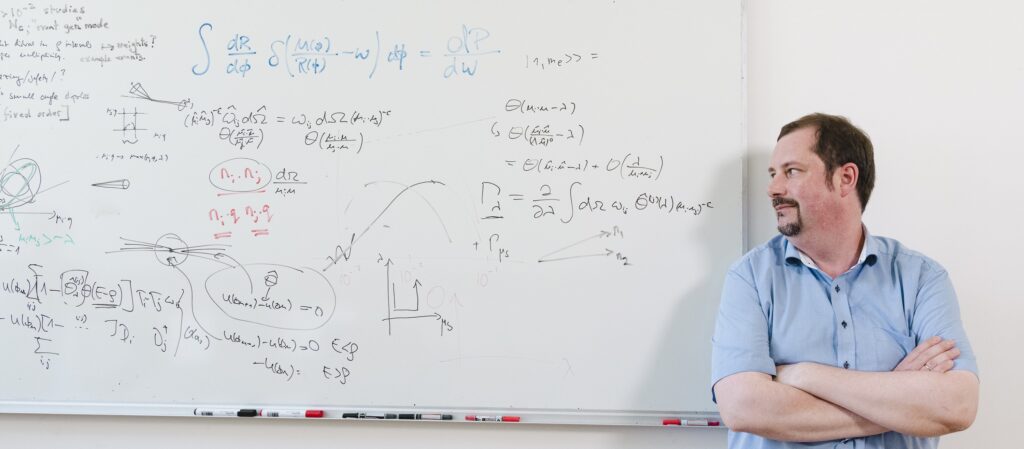
Universität Siegen, Fakultät IV/Department Physik, Theoretische Physik 1, Walter-Flex-Straße 3, 57072 Siegen, Germany
Office: ENC B-131, Tel.: +49 271 740-3705, Fax: +49 271 740-3804
Research: Understanding and simulating complexity
We work on the phenomenology of elementary particle reactions, centred at the interface between theory and experiment. What we want to know is how the data acquired at particle collider experiments are telling us about the fundamental constituents and forces of nature, and how the complexity observed in high energy reactions emerges from simple building blocks. This is only possible by combining a large range of methods from analytic calculations to fully detailled Monte Carlo simulations. We apply these methods to the strong interaction, to electroweak interactions, as well as to hypothetic dark matter particles.
We are involved in several international networks like MCnet and COMETA, and have ongoing collaborations with researchers at Karlsruhe, Lund, Manchester and Vienna.
If you are interested in a thesis project please contact me in the office or by email.
Current topics of interest
- Event generators, parton showers and hadronization models: We design and analyze parton shower algorithms and hadronization models which describe how jets, collimated bundles of hadrons, emerge from a a hard scattering, and we want to understand how these simulations need to be adapted for complex heavy ion collissions. We are experts on including precision calculations in event generators, and all of these activities provide major contributions to Herwig 7, one of only three versatile packages used at collider experiments.
- Analytic resummation and amplitude evolution: We are world-leading in building a new approach of parton evolution at the amplitude level which is including quantum mechanical interference from the beginning. The method is suited to be used as a tool for analytic resummation, as well as the basis of a next generation of event generators. It also teaches us how we can simulate the infrared structure of scattering amplitudes beyond common apprpximations. This activity is driving the development of the CVolver library.
- Conceptual aspects of quantum field theory and its simulation: If we want to predict and simulate detailed final states, then the knowledge of the dynamics of observed bound states and thus non-perturbative quantum field theory is inevitable. One of our most recent activities focuses on some of these field-theoretic questions, as well as on formulating and simulating quantum field theories on a lattice.
- Monte Carlo methods: Simulation is our central tool, and so are Monte Carlo algorithms. We in particular work on Markov chains in presence of negative transition rates, adaptive integrators and samplers, resampling algorithms, and algorithms for the evolution of density operators.
- Algebraic tools, loop calculations and group theory: The building blocks of our simulations require dedicated perturbative calculations, for which we develop algebraic tools for (one-)loop integrals, spinor helicity, chirality flow, and for cuts and loop integrands. Gauge theories require us to use modern group-theoretic approaches such as birdtracks, for which we develop efficient calculational algorithms.
- Phenomenology: The link to experiments is the backbone and application of our research. We study new observables and determine how precise our simulations are. This involves statistical knowledge as well as high-dimensional parameter fits and is done in close interaction with experimental colleagues.
Group Members:
- Dr. Dominic Stafford
- Dr. Prem Agarwal
Publications
Citation Summary (from inspirehep.net)
Teaching:
Winter term 2026/27
- Monte Carlo methods